Know which features your highest‑value customers actually want
Gridlogs extracts product demand from sales calls, ties every request to customer revenue, and ranks your backlog so you build what moves the number — not what got mentioned last.

_logo.svg.webp)


How it works
From sales call to ranked backlog in four steps
Connect your calls and CRM. Gridlogs extracts the demand, ties it to revenue, and delivers a prioritized backlog your team can act on immediately.
Connect the calls and CRM
Bring Gong or Fireflies transcripts into one workspace, then connect HubSpot so every mention can be matched back to the account that asked for it.
Extract and cluster product demand
Gridlogs turns raw transcripts into structured feature demand, groups similar requests together, and keeps the source evidence tied to every cluster.
Rank what matters by revenue
Mentions are weighted by customer revenue so the backlog reflects the commercial value behind each request, not just how often it came up.
Push the strongest demand into Linear
Send the highest-value features into Linear with synced context, account evidence, and issue state that stays tied back to the source cluster.
Platform
Extract. Rank. Sync. All in one pipeline.
Three connected surfaces so the evidence in a customer call reaches Linear with the revenue context still attached.
AI extraction purpose-built for sales calls
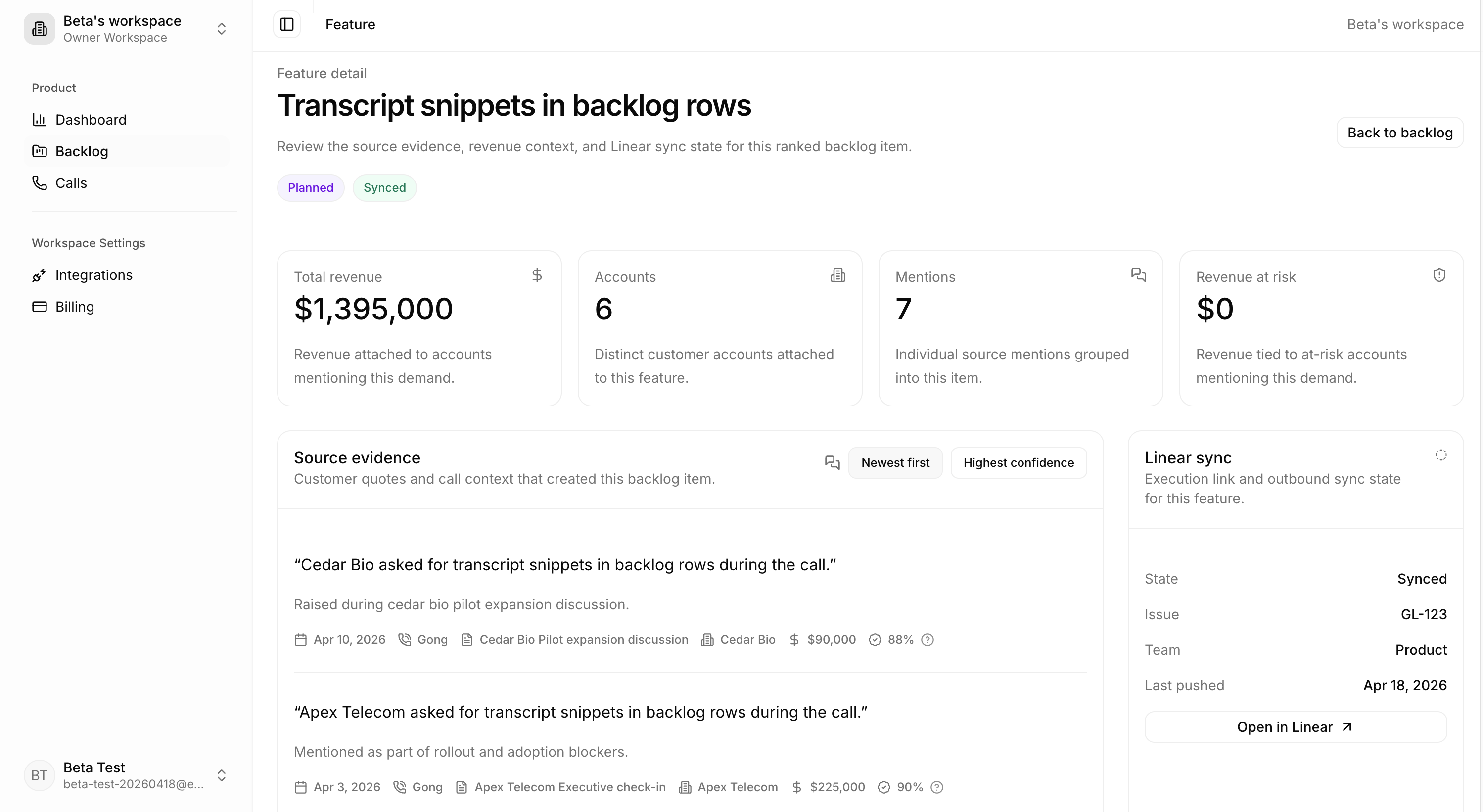
Gridlogs turns long transcripts into structured product demand, preserving the exact wording, account, and context behind every mention so PMs can audit the evidence instead of trusting a summary.
- Transcript-to-feature extraction with source snippets
- Duplicate requests clustered into one theme
- Full call context preserved on every mention


A backlog ranked by revenue, not volume
The backlog surfaces the features tied to the most revenue, the most accounts, and the most recent demand so prioritization starts from commercial reality.
- Total revenue, account count, and mention count on every row
- Drill-in evidence for quotes, calls, and requesting accounts
- One ranked view instead of scattered notes and spreadsheets
Linear sync that keeps the evidence trail intact
When a cluster is worth actioning, Gridlogs pushes it into Linear with the context product teams need and keeps the source evidence connected to the issue.
- Push clusters directly into your existing Linear workflow
- Revenue summaries and request context stay attached
- Track synced versus out-of-sync backlog items at a glance


Why Gridlogs
Most feedback workflows lose the revenue trail
When customer demand lives in notes, recaps, and scattered tickets, prioritization gets driven by memory. Gridlogs keeps the evidence and the revenue together.
Scattered feedback flow
The risky way
- Rely on scattered call notes and Slack threads
- Count mentions without seeing account value
- Lose the source evidence behind each request
- Prioritize the loudest voice instead of the biggest opportunity
- Rebuild the same spreadsheet before every roadmap review
- Push issues into Linear with no commercial context
Gridlogs
Revenue-weighted prioritization
- Turns transcripts into structured product demand
- Ranks feature clusters by revenue, accounts, and mentions
- Preserves the quote, call, and account behind every request
- Creates one revenue-weighted backlog the whole team shares
- Connects Gong, Fireflies, HubSpot, and Linear out of the box
- Keeps prioritization and execution in sync
FAQ
Common questions
Gridlogs is not another feedback bucket. It is a direct path from raw customer conversations to backlog decisions grounded in revenue.
What does Gridlogs actually do?
Gridlogs ingests sales calls, extracts product requests, maps them back to customer revenue, and turns that into a ranked feature backlog your team can actually use.
Which systems does the current product connect to?
The current Gridlogs workflow is centered on Gong or Fireflies for call ingestion, HubSpot for revenue context, and Linear for backlog sync.
How is this different from a feedback board?
A feedback board collects requests after someone has already summarized them. Gridlogs starts from the original sales-call evidence, clusters the demand automatically, and weights it by customer revenue before it reaches the backlog.
Can I see the original evidence behind a feature cluster?
Yes. Every cluster links back to the original quotes, calls, and accounts so product teams can inspect the evidence directly — not just trust a score.
Does Gridlogs replace Linear?
No. Gridlogs is the intelligence layer before execution. It helps you decide what belongs in Linear and syncs the context into the workflow your team already uses.
Who is this for?
Gridlogs is built for B2B SaaS teams that already have customer conversations happening in call-recording tools but still struggle to turn that raw feedback into a commercially grounded backlog.
See how your backlog looks when it is ranked by revenue
Connect your calls and CRM. Gridlogs does the rest — extraction, clustering, revenue matching, and Linear sync.
Book a demo